One of the most common mistakes I see in amateur music notation looks something like this:
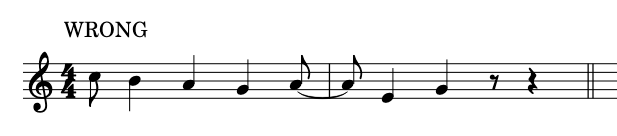
This is wrong, and I’ll explain why in a moment. But as modern popular music became increasingly fond of syncopation, so unfortunately did musical literacy decrease, and music software failed to keep up with the lack of proficiency in the users. It is quite possible for someone to write into Sibelius, Musescore or Finale the above rhythm; the software won’t fix it or flag it with the equivalent of Microsoft Word’s squiggly green or red underline to indicate a spelling or grammar error.
As a side note, Dorico, developed fairly recently, is the outlier here: you could have no clue how to write rhythms correctly, but it will take care of where to show the divisions of the beat etc. Someone there had their head screwed on.
For these examples I’m using Sibelius, which is my software of choice. I will default to the British terms for note values (so Americans half-notes = minims, quarter notes = crotchets, etc.)
So the above rhythm is written incorrectly because it fails to show the division of the beats clearly enough. In a bar of 4/4 one must always show the half-way point of the bar, even if one has to write, for example, two tied quavers instead of a crotchet. It may sound the same as another crotchet, but to the music reader, this difference is critical; it stops us from getting lost in the half-way beats, wondering which beat we’re on, whether this crotchet fell ON a beat or OFF it. Whatever the rhythmic complexity of the bar, it is essential to help the reader identify where the beat falls as much as possible. Here is the correct version of the above:

Other egregious examples may abound:

Again, the notation does not follow the proper subdivision of the beat. In 6/8, the division must show a division half-way through the bar (3+3 quavers). Conversely, a bar of 3/4 should show three crotchet-length beats. There may be a minim plus a crotchet in 3/4, but certainly not in 6/8. The minim does not disrupt the individual beats in 3/4, because there is a clearly defined break on the third beat with the new crotchet; but in 6/8 it would entirely obfuscate that new ‘beat’ on the 4th quaver of the bar. It would have to be a dotted crotchet tied to a quaver, followed by a new crotchet.

Here are some more:

In 12/8, one needs to show four groups of 3 quavers, or at the very least, two groups of 6 quavers, which could be further broken down into 3+3 each.

Or how about this curiosity:

In 5/4, one needs to be consistent with breaking down into 2+3 beats, or 3+2, or to very clearly state in the score when and if the internal subdivisions alternates.

Of course, minor exceptions are perfectly allowable – a semibreve can fill a 4/4 bar; there is no need to tie two minims. A dotted minim will suffice to fill a bar of 6/8. Etc.
To look at a more crazy example, here is a riff from Snarky Puppy’s track ‘What About Me?’
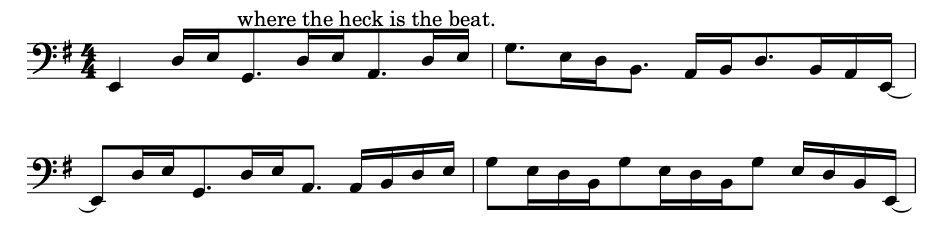
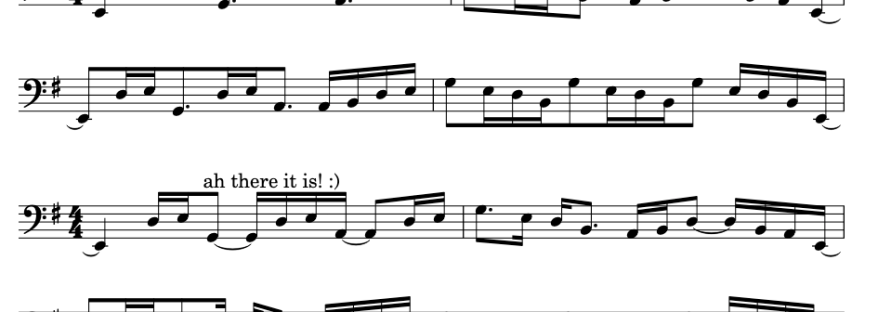
Even though it sounds like a lot of 2+3 semi-quavers (16th notes), it is not helpful to just write it like that, for again the reader loses sense of place within the beat. Syncopation only works because it is played against the beat; the player should have a sense of how much they are playing against it to know how to play it well! Thus the correct way to notate it would be to involve tied notes into each new beat:
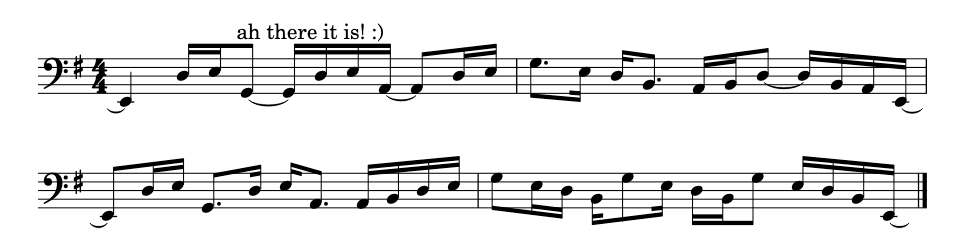
I hope this provides a helpful guide as you go on trying to ‘keep in step’ with your notation. If unsure always lean on the side of showing more beats of the bar. Generally the music reader will thank you.


