Emily
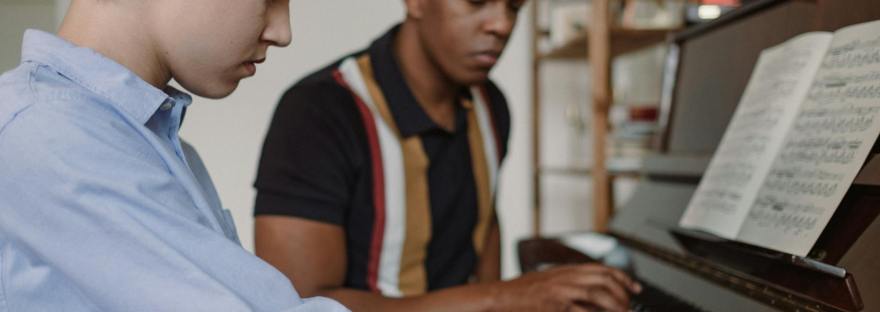
Emily (not her real name) sits at the piano, legs swinging several inches from the floor on the grown-up stool, spreading her fingers as best she can over the full-size black and white keys. She is showing lots of promise at her young age. I have recently started teaching at Emily’s school, and am still familiarising myself with the place, the names, the abilities. This one is a bright one.
I reach for my iPad which I have brought with me today in lieu of having all my paper-based teaching materials. I had hoped it might lighten my backpack a little, already weighed down by a packed lunch, a bottle of water, a wallet, a piece of Lego my son gave me as I ran out the door – the usual trinkets of life. Plus, bringing the iPad means the pencil case can stay at home. Light and agile, that’s my motto today.
I bring up Emily’s book on the screen, which I had carefully scanned in at home so it is replicated on the iPad. Except, I have to slightly fiddle to find where I had saved it among a wealth of PDFs in my music-reading app of choice – there’s a LOT there. When I eventually land on it, something funny happened to the rotation of the page I had landed on, and Emily promptly informs me she has in fact already mastered this piece. We flick the screen to the next one. Something else funny has happened to the scan of this page, but we can just about make out the lines of the staves, the shadows that should be notes, so here goes. Place your thumbs on Middle C…
Emily is only 7, but after a minute or two more of this, seeing the experiment I am going through, she cheerfully and in no uncertain terms tells me she prefers the book version. I sigh and nod my head. So do I. She then reminds me she actually has a copy of the book herself, and we go and fetch it from her bag.
‘Ed’
It’s all the rage of course. Interactive whiteboards, the latest online apps and services to deliver learning to children (and make teachers’ lives easier by automatic marking) – these are the current trends in an industry with its own cute little diminutive name: ‘Ed Tech’. (I once met Ed. He seems like a nice guy.)
Under the diminutive surface though, there’s a lot going on. I heard a quote mentioned anecdotally and in passing recently – which is my excuse for not knowing or being able to find the source – but it was something along the lines of this: ‘Education technology is a revolution that has been coming for 40 years – and we’re still waiting for it to arrive.’ Technology pervades our classrooms, being used in every subject, at every turn, from whiteboards to iPads, and at best, is being integrated alongside other learning tools. Yet no one is quite sure at what point to say we have achieved full Ed Tech literacy or transformation of the classroom. Much of the time, it still seems to get in the way.
Such as for me and Emily, in that moment, where it wasn’t quite cutting it the way more traditional learning tools have. The abstraction of the screen put a barrier between us and the page – no matter how much Apple wants you to believe that there is nothing between you and the content on the screen. There is actually a lot there, which we might summarily call ‘a host of mental processes to try to correlate the virtual version of what you’re seeing to the physical correspondence we’re used to interacting with in the world around us’. Learning experts will tell us that engagement with our 3D physical environment has a great deal to do with how we learn. This is the basis of some of the breakthrough methods of Montessori schools, for example.
As a peripatetic music teacher, I am a great deal aware of this, and have the pleasure and privilege of encountering the charms of learning through the physical environment each time I sit down with a pupil and our instrument(s). There is no replacing the feel of guitar strings, the vibration of sticks in your hands as you hit the drums, or the give of piano keys under your fingers. These tactile experiences play a tremendous part in learning an instrument. So why would I also introduce the barrier of a screen when it comes to reading music?
It turns out, I don’t really need to. For one thing, if I were to weigh the printed materials I need to bring with me on any given day into a school, they would be about the same as an iPad with keyboard case (for convenience) and smart pencil. With every student that brings their own book to school, this further reduces the potential load on my back. So weight isn’t really a problem.
Enjoyment
As a trade-off, we get to use physical books: Kids get excited about seeing how-far-through they are; there is a tangible sense of progress, visible by the number of pages turned. The pride they take in their own copies is visible on their faces (and in the wear and tear of their copies). The notes we make in their copies travel home with them, visible when they get them out for practice.
It’s also a breeze to whip out an actual pencil (which doesn’t need charging, only sharpening, which is sort of more fun than scrabbling around for a charger), and jot something down on paper. Furthermore, I can keep my notebook for tracking lesson progress open to the side while using the manuscript pad for jotting things down, and the printed book for official learning material. If I were trying to use the iPad for all of these tasks, I’d be jumping between apps like a digitally-frenzied rabbit.
Also my notebook doesn’t ping me with nuisance notifications.
I could go on, but I think you get the point. The digital tools that bear so much promise actually turn out to fall far short of their analogue counterparts in offering a good educational experience, and introduce a host of pitfalls and distractions besides. I now teach screen-free, using a mixture of printed materials (my own or published books), manuscript paper, and a notebook. The combination is wonderfully effective. And unsurprisingly, there’s only so much to distract the students – or me – from what we’re supposed to be doing. The environment, centred around the physical objects of the instrument and the music we are reading, keeps us focused and engaged. The only time I will use my phone is for a metronome to keep time, or a tuner app, and that’s if I don’t feel we have the time to tune a guitar the old fashioned way and ‘use our ears’, which I have been favouring more lately too. I will put the device away again as soon as we’re done with it. And thanks to built-in metronomes or clip-on tuners, even these uses are becoming redundant.
I have no doubt that Ed Tech is going to stick around; and hopefully he won’t be constantly plaguing our corridors like an annoying deputy always trying to elbow their way into lessons; he may learn to settle quietly alongside the mainly non-digital activities of the classroom. Until then, I’m keeping the door firmly shut on him and doing what has always worked: Screen-free learning.

 ben trigg music